Note that this post also appeared as a newsletter on July 20, 2026.
Imagine a world where everyone is walking around with a small, highly trained and individuated bot in their pocket that can spit out a novel given the right prompt. Imagine not being able, or allowed, to make things up. Imagine not knowing if something is made up or aggregated. Imagine being allowed to not know something about the world. Imagine wanting to know something and having to try to figure it out. Having to figure out how to figure it out.
This is why I like browsing in libraries so much. And not just browsing for things to read, but plunking myself down in a section like geology or art history and just picking up and reading through a bit of every book within reach. I become the algorithm in such a scenario; whatever my hand alights on is what shows up in my ‘results.’
This requires an elasticity of mind. It is much more nuanced than web browsing. In fact, so averse am I to the word “browser” that the original meaning intended—to browse and choose the best parts, the the tender shoots plucked or nibbled by grazing animals or knowledge seekers—feels sullied by the later algorithmically corrupted noun.
When I first decided I was actually going to try and become a writer, I set myself the task of writing a novel on a typewriter. It was 2013, and at the time it seemed like an appropriately quaint bit of masochism: if I could do that, I reasoned, then I could probably hang in an MFA and beyond. A typewriter, to my millennial brain, introduced an element of difficulty, patience, learning and fighting with ink tape and outdated technology that put another barrier between me and the work. It was like the Rocky montage but for the deskbound writer. My museum steps were the leaden gray stems of the letters beating out a rhythm on my copy paper.
I did finish that novel. It was about two friends, one trans woman and one cis woman, both of whom were studying the history of women in medicine, the story of their competitive friendship interwoven with the story of two of Harvard Medical School’s first women to enroll in the late 1800s. It wasn’t very good, and I never tried to publish it, but I did finish it. I can still feel what it felt like writing that book, how exciting it was to punch away at the keys and watch the stack of pages grow on my desk. It could be due to the rush of finishing the first book I ever tried to write, but I believe that the physical act of typing as mark-making, rather than as electrical impulse speaking to a machine, is the main reason it sticks out as my most tactile writing memory.
I was thinking about this while reading about several scandals in the literary journal world wherein editors have been duped by writers submitting work written using generative AI. (This was initially brought to my attention by one of smoke and mold’s managing editors, Carol, while we were putting together our own anti-AI statement for smoke and mold. Thanks, Carol!) I don’t really want to go into here the precise details of these scandals—not to save anyone face, but because I find them a little bit boring with all the handwringing and soul searching on the part of those who have been duped. While the editors produced an interesting (and very long) report on their process in determining which writers used AI, they also were reading submissions anonymously and didn’t require cover letters. (In my experience, an AI cover letter is much easier to spot than an AI-generated story.) I find it funny to imagine all the absurd ways someone might be asked to prove they aren’t writing with AI: submit your typewritten manuscript, write a full story while someone else watches. And I return to one of my earliest questions as an academic: do the tools we use to read and write impact what we sound like, and what we understand?
This question formed the basis of my undergraduate thesis, “Scroll to eBook: Different Modes of Reading and Their Impact on Understanding.” It was 2010 and I was a human geography major, so people were understandably nonplussed at my choice of subject. Books would soon be extinct, after all! (lol) But I have always felt a deep connection between the physical reality of books and the messages they contain. It’s why I can’t read ebooks or audiobooks. Without the physical object in my hands, the message is different. At the time I theorized that if digital readers became the primary means of engaging with literature, this would change something deeply central to the project of writing and reading. The message would be altered. Most of the research at the time was focused on how reading physical newspapers differed from online journalism, and I think we can see where that has gotten us.
We don’t really know what it means to write a human book. Thousands of years of writing and innovation haven’t landed on an answer, and that was before the question took on a certain slant when viewed alongside content generated by artificial intelligence using the same letters and bits of data as we do on our word processors. It is naive to assume that this is an easy question to answer. And to me, that makes it a very exciting question. It is an extension of a very old question under new conditions. It is not a question that is independent from hardware, technology, and profit—all of which have always been implicated in the project of literature since it emerged alongside modern capitalism. But as we leave capitalism behind for something accelerating darkly, something more extractive, something looking to colonize distant worlds, I do think it’s worth taking the question seriously. What is a human-made book? If we no longer punch the keys, if we have no manual role in putting the words down, what is it that makes the book a product of our mind?
Interestingly, there is an article linked in the notes of this report, titled “Assessing Language Models’ Worldview for Fiction Generation.” The abstract finishes with “We highlight the limitations of current LLMs in fiction writing and advocate for future research to test and create story worlds for LLMs to reside in.” And I am confused. If one team is trying to make the computers better at writing fiction, and the other team is trying to get better at identifying and rejecting fiction made by bots, then where are we heading? What kind of weird word-race have we entered into, and what does it mean?
Note that the distinction here between computers and bots are important. We use computers to write our books, but we don’t use bots, apparently ( unless we do, and we state it openly.) And more and more I wonder where the line is. I thought I might have found it recently when I was going through old family photos. My grandparents were both published writers of scarce renown. They both taught English at different colleges in my hometown, both published novels, and together they edited many short story anthologies. This particular photo is from around 1979. I have no idea what he’s typing on, but it looks dumb as hell and I want one.
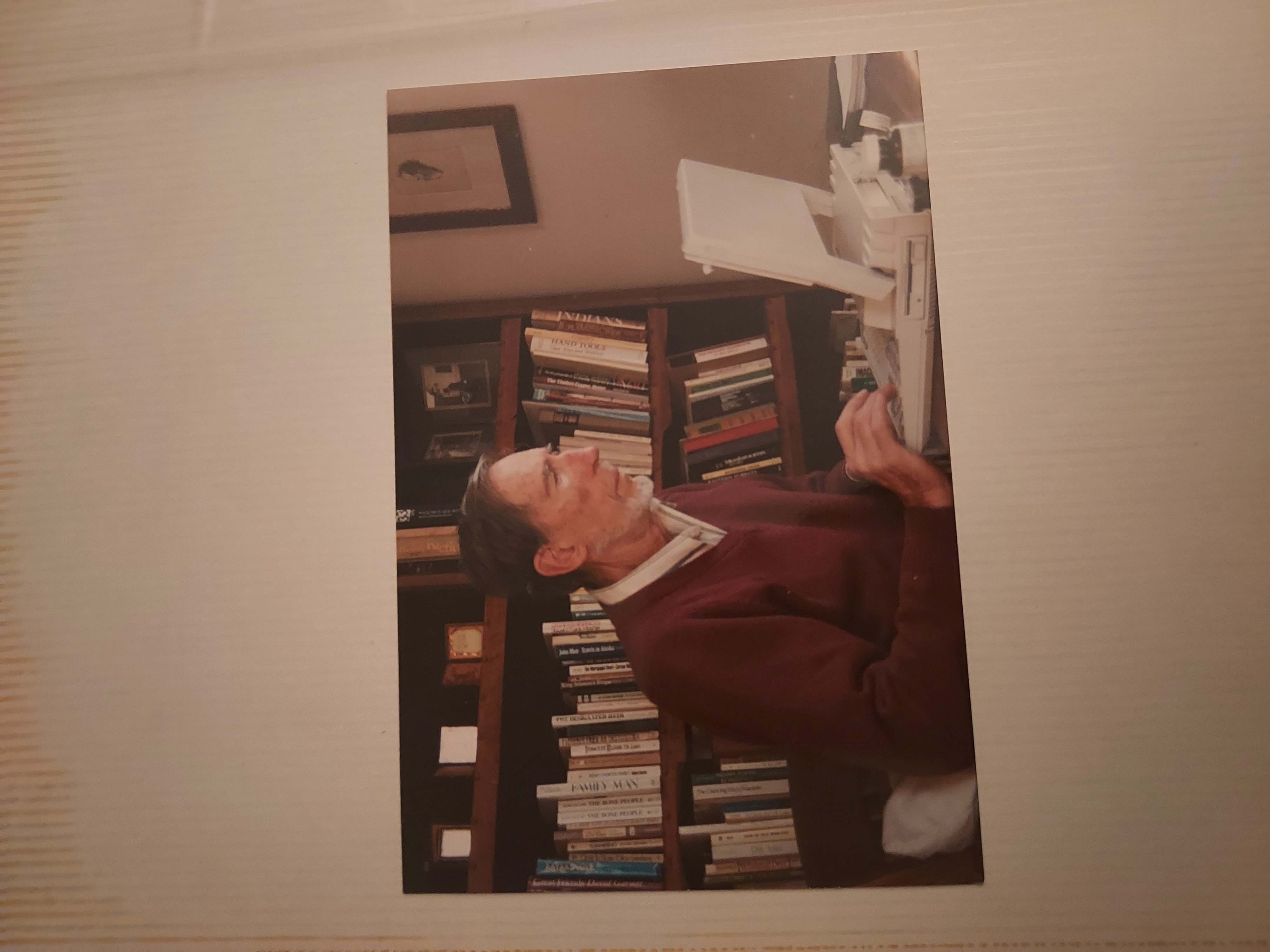
In case it isn’t obvious: I don’t personally use any AI tools when writing, composing, drafting, or revising. I turn off all autocorrect features and suggestions, and increasingly write longhand or have returned to the typewriter for composing drafts. I own two Webster’s Dictionaries, one unabridged from 1978 and one collegiate edition from 1998. I use them everyday. I have a copy of the 18th edition of the Chicago Manual of Style, recommended by my publisher when I was composing end notes and formatting quotations for STREAM. I remember definitions and etymologies better when I look them up first in a dictionary, rather than typing them into a search engine and reading the first results. When not looking for news on current events, I have come to treat internet search engines like time capsules: I set my search parameters to only include results from 2001-2021, thus eliminating the AI listicles and clones that have bred like bacteria since LLMs were unleashed. For new information from the last five years—scientific studies, contemporary literature, etc. —I turn to the public library’s robust search engines and free resources, as well as those of museums, and a small ecosystem of digital journals covering literature and politics I have known and followed for years. The next and probably final step will be divesting from Google: email, photos, file storage. This is a daunting task, but I’ve started keeping hard copies of all manuscripts completed, and I try to keep physical drafts from pivotal moments in composing or recomposing a book.
I remind myself frequently that we ended up here because we were moving too fast and we weren’t thinking hard enough or weird enough. So I try to move slower, think harder, be weirder. Despite all the technological hand-wringing, there is more room for taste in this discussion than most people are willing to admit. We can expect higher standards from our writers than simply not using AI. I try to keep in mind that AI writing is so atrocious in the first place because it was trained on reams of bad writing by humans, a result of Amazon self-publishing and a lack of book review outlets and an unwillingness to write honest reviews of bad books. The conclusion may be that the drive to increase profit weakens literature.
Recently I was showing off my new nature journal section of my personal website to a friend. I was proud that I’d figured out how to code it, but as we sat waiting for the images to load I apologized for the slowness, images loading pixel by pixel. She responded that she felt it introduced an element of anticipation to the experience usually unavailable in instant gratification internet land or in physical media. This again is emblematic to me of a certain kind of value of the pre-AI, pre-social media internet. The waiting. Dialing up, loading screens, the spinning wheel. That little hour glass that turned over and over. It was assumed that internet users wanted faster speeds, that they would want to do away with the waiting, but I’m not so sure that was true. What if the slow internet was the best version?