How do you know when you’re at the start or the end of something? Is this just another way of approaching the question of infinity? M.C. Escher, who spent a lifetime on this question, said:
“Anyone who plunges into infinity, in both time and space, further and further without stopping, needs fixed points, mileposts, for otherwise his movement is indistinguishable from standing still. There must be stars past which he shoots, beacons from which he can measure the distance he has traveled.”
One would be forgiven for thinking that this problem would be much simpler on the scale of decades rather than light years. But that hasn’t been my experience. Advanced capitalism, the dying paroxysms of white exceptionalism and US imperialism on the global stage—these are tempting to label as beginnings of an end. And it’s true that you can’t know how long an end takes. An end might take decades, or centuries, and it will contain many more beginnings besides. But on the scale of one human life creating art and fighting for a better world, figuring out how to create meaning with and around these beginnings and endings is the challenge.
A writing professor of mine once told me that the very first sentence of a story should contain some kernel of knowledge of its end. And I suppose this is desirable if you’re pursuing an Escherian symmetry. If symmetry is the porthole through which you view the world. Beginnings and endings intertwined in an unbroken Möbius strip of time and experience and narrative. There are mathematical rules by which one can pursue this sort of fractalization of story, but I write so that I don’t have to do math.
I would argue that narrative symmetry isn’t something trans life pursues. It’s naive to assume someone’s life is devoid of symmetry just because they ended it as a different gender than they started out as. And yet, I find a lot of the trans writers I’ve worked with (and I’m including myself in this construction) have a difficult time letting go of the initial asymmetry of their story. For some, the asymmetry becomes inseparable from the story itself. It becomes the reason for the story. And what’s wrong with that?
When I’m reviewing a story I’m looking for intention on the page. This is a line you’ll hear many editors use, but it’s rarely followed up with a why. I think it's because there is a symmetry to intention. Intentions thwarted over and over, missing their associated actions, are one of the great injustices in the world—intention to get an ID (a sisyphean task achingly rendered by Paul Susi in his wonderful recent book Character Work), the right of return, and more. An unfulfilled intention is the greatest sorrow. This is what the story must answer. It doesn’t need to fulfill every intention of the characters—or even any of them—but the writer’s intention must be realized.
Sometimes I have to fight against my own desire to fulfill an intention that is mine and not the writer’s. But the longer I do this the better I’ve gotten at recognizing the difference. What is harder, I think, is for the writer to realize how their own intentions change the longer they write, both on the scale of their life and within a single story. To understand that giving up on perfect asymmetry might be just what they need. It’s when asymmetry stands in the way of intention that the writer stagnates. Clinging to an original intention without considering how it has grown and changed since we started is to willfully ignore the ways in which we’ve substituted asymmetry for symmetry or perfection.
Asymmetry is beautiful. It reminds us of imperfection, to see beauty in the flawed. To reject, actually, the ruse of perfection and striving and the Normal. But asymmetry doesn’t mean rejecting growth; you can’t have asymmetry without symmetry. I like to think of them as more of a spectrum than a binary. If you’re working within any kind of literary form (i.e. not utilizing hybrid or visual elements, i.e. plain old book words) you will have a beginning and an end. It is unavoidable, like life. The complete rejection of symmetry for asymmetry, or vice versa, is untenable; rather, realizing that as a writer you’ll be constantly changing and moving between symmetry and asymmetry and learning how to recognize your own tendencies within these poles is key.
After more than a decade living there, Escher fled Italy in 1935. He wasn’t Jewish as far as I know, but as for many artists, living under fascism was intolerable for him and his family. Like many who flee war or famine or persecution, his life was asymmetrical. From it, he made the most dizzying symmetry, peculiar for how it is constantly inverting itself and starting over from multiple points.
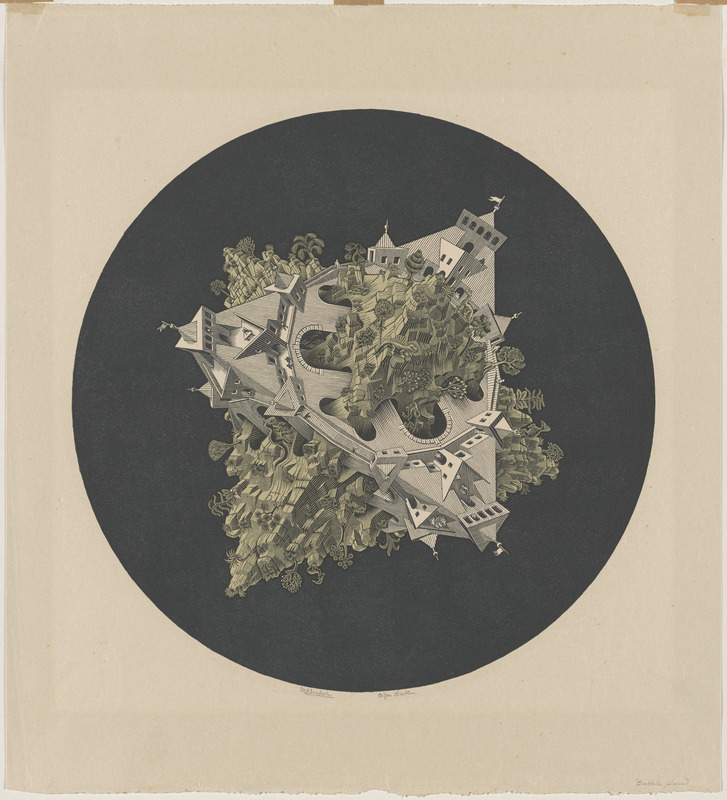
Double Planetoid, MC Escher, 1949. In the collection of the Boston Public Library.